


Description
NAVBasics (3 book set) – Third Edition
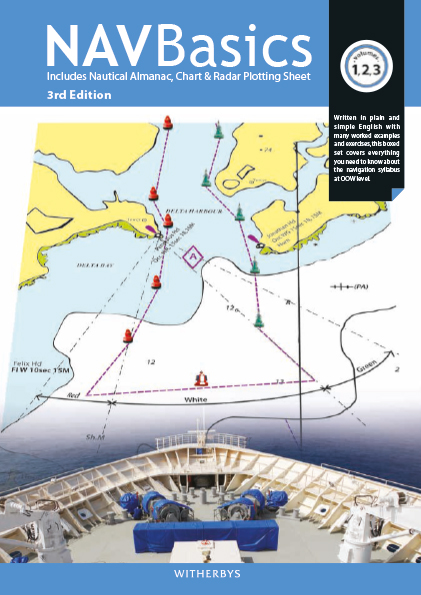
NAVBasics (3 Book Set) – Third Edition is a comprehensive navigation training book designed for junior officers preparing for OOW-level studies. It provides clear explanations, practical examples, and structured exercises covering the full navigation syllabus.
The navigation training book provides a complete foundation in marine navigation for junior officers. It covers key theoretical concepts and practical applications required for safe and effective navigation at sea.
This three-volume set includes topics such as coastal and ocean navigation, passage planning, tides, celestial navigation, radar navigation, electronic navigation systems, and watchkeeping procedures. The structured layout, diagrams, and exercises make it ideal for both study and practical understanding.
The content aligns with international navigation standards and supports training based on guidance from the International Maritime Organization (IMO).
Why This Navigation Training Book is Essential for OOW Preparation
Navigation is a core responsibility of deck officers, and strong foundational knowledge is critical for safe vessel operations. This book helps students understand key principles and apply them in real-world navigation scenarios.
For deeper passage planning and navigation practice, this guide works effectively alongside Passage Planning Principles – Second Edition and Passage Planning Practice – Second Edition, supporting both theory and application.
It also complements operational navigation guidance such as Bridge Procedures Guide – Sixth Edition and situational awareness resources like Rocks and Hard Places: How to Avoid Them, with additional navigation publications available in the deck department industry bodies collection.
Who Should Use This Navigation Training Book?
This book is ideal for deck cadets, junior officers, and maritime students preparing for OOW certification. It is also valuable for training institutions and onboard learning programs.
Whether used for structured study or practical revision, this guide provides a strong foundation for safe navigation and professional development.
Contents Listing:
Volume 1
1 The Earth
1.1 Shape of the Earth
1.2 Position and Directions on Earth
1.3 Magnetic Compass and Compass Error
1.4 Gyro Compass
1.5 The Navigational Chart and Projections
1.6 Chart Production
1.7 Interpretation of Information on Charts
2 Coastal Navigation
2.1 The Basics
2.2 Tools for Chartwork
2.3 Plotting Bearings and Courses on Chart
2.4 Plotting Distances on the Chart
2.5 Plotting Latitude and Longitude on a Chart
2.6 True and Compass Course Conversion
2.7 Fixing Position
2.8 Leeway
2.9 Checking Position by Soundings
2.10 Running Fix
2.11 Doubling the angle on the bow
2.12 Vertical Sextant Angle
2.13 Horizontal Angles
2.14 Offshore Danger Angles
2.15 Clearing Bearings
2.16 Chart Work Errors in Plotting
3 Tides
3.1 Formation of Tides
3.2 Meteorological Effects on Tides
3.3 Under Keel Clearance
3.4 Overhead Clearance
3.5 Tide Calculations
3.6 The Pacific Tides
3.7 Tidal Streams
3.8 Tidal Stream Data are given in ATT
3.9 Use of Computer Programs to Obtain Tidal Information
4 Passage Planning
4.1 Planning – Principles
4.2 Planning Stages
4.3 Procedure for Chart Selection
4.4 Passage Planning Example
4.5 Passage Planning Checklist
4.6 Chartwork Legends
4.7 Reasons for Notice to Engine Room
4.8 Wheel-Over Point Calculation
4.9 Passage Planning with ECDIS
4.10 Additional Considerations for Passage Planning with ECDIS
4.11 Use of Admiralty Routeing Guides for Passage Planning
4.12 Use of Admiralty Routeing Charts for Passage Planning
5 Nautical Publications
5.1 Introduction
5.2 The Nautical Almanac
5.3 Admiralty List of Lights and Fog Signals (ALL) – Paper Based
5.4 Catalogue of Admiralty Charts and Publications (NP 131)
5.5 Admiralty Tide Tables and Tidal Stream Atlases
5.6 Admiralty List of Radio Signals (ALRS)
5.7 Publications for Fishermen
5.8 Admiralty Sailing Directions (Pilot Books)
5.9 Nautical Tables
5.10 Mariner’s Handbook (NP 100)
5.11 International Code of Signals
5.12 Standard Marine Communication Phrases (SMCP)
5.13 Weekly Edition of Admiralty Notices to Mariners (ANM)
5.14 Annual Summary of Admiralty Notices to Mariners (NP 247)
5.15 Cumulative List of Admiralty Notices to Mariners (NP 234A and NP 234B)
5.16 Chart Correction Log and Folio Index (NP 133A)
5.17 M-Notices
5.18 Ocean Passages for the World (NP 136)
5.19 Miscellaneous Publications
Volume 2
1 Ocean & Offshore Navigation
1.1 Trigonometry
1.2 Using Napier’s Rules
1.3 Rhumb Line Navigation
1.4 Great Circle (GC) Sailing
1.5 Proofs
2 Celestial Navigation
2.1 Sextant
2.2 Celestial Coordinate System
2.3 The Horizon Coordinate System
2.4 Time and Time Measurement at Sea
2.5 The Compass Error
2.6 Sextant Altitude
2.7 Meridian Passage
2.8 Celestial Position Lines
2.9 Latitude by Meridian Altitude
2.10 Polaris
2.11 Marcq St Hilair or Intercept Method
2.12 Longitude by Chronometer Method
2.13 Position by Multiple Simultaneous Observations
2.14 Planning Sights
Appendix 2. Additional Reference Material
Volume 3
1 Navigation and Watchkeeping
1.1 Phases of Navigation
1.2 Methods of Navigation
1.3 Navigation in Ice
1.4 Watchkeeping Procedures
1.5 Watchkeeping at Anchor
1.6 Watchkeeping with Pilot
1.7 Circumstances in which the OOW Should Call the Master
1.8 Watchkeeping in Emergencies
1.9 Shipboard Communications and Alarm Systems
1.10 Record Keeping and Logbooks
1.11 Introduction to IALA Maritime Buoyage System
2 Electronic Navigation
2.1 Electronic Charts
2.2 Global Navigation Satellite Systems (GNSS)
2.3 NAVTEX
2.4 Hyperbolic Navigation Systems
2.5 Automatic Identification System (AIS)
2.6 Voyage Data Records (VDR)
2.7 Ship Security Alert Systems (SSAS)
2.8 Integrated Bridge and Navigation Systems
2.9 Echo Sounder
2.10 Speed Logs
3 Radar Navigation
3.1 Radio Wave Basics
3.2 The Radar System
3.3 Controls and Initialisation of a Marine radar
3.4 Checking Heading Marker Alignment
3.5 Use of Radar for Making a Landfall and Radar Horizon
3.6 Weather Factors Affecting Radar Abilities
3.7 Other Factors Affecting Radar Abilities
3.8 Use of Radar for Navigation
3.9 Radar Presentation and Display Modes
3.10 Radar and Electronic Charts
3.11 Radar and AIS
3.12 Radar and SART
3.13 Radar Plotting
3.14 Use of Radar for Collision Avoidance
3.15 Automatic Plotting Aids
3.16 Automatic Radar Plotting Aid (ARPA)
This book set is an essential training resource for developing strong navigation skills at the OOW level. By combining theory, practical examples, and structured exercises, it helps future officers build confidence and competence in safe ship navigation.
Frequently Asked Questions
What is this navigation training book used for?
This book is used for learning and practising navigation at OOW level, including passage planning, tides, and radar navigation.
Who should use this book?
It is suitable for deck cadets, junior officers, and maritime students.
Does it cover celestial navigation?
Yes, it includes celestial navigation concepts and practical methods.
Does it include exercises?
Yes, it contains worked examples and exercises to support learning.
Is the navigation training book useful for exams?
Yes, it is widely used for OOW exam preparation and revision.


Reviews
There are no reviews yet.